


.jpg)

Blog//
How AI Agents Are Transforming IT Support on ServiceNow
August 17, 2026
August 15, 2025
A frustrated employee runs into an error. Instead of writing a detailed support ticket, they take a screenshot, attach it, and hit submit, hoping the IT team will somehow figure it out.
Multiply that by hundreds or thousands of users.
Now add the time it takes for support teams to interpret those vague screenshots, ask follow-up questions, and triage the issue manually. That’s time-consuming and expensive (plus frustrating for everyone involved).
And a blurry screenshot of… something. Maybe a 404. Maybe their desktop background.
This is the silent productivity killer that sparked the development of a new breed of AI agents, launched on the ServiceNow Store by our Enterprise AI Services team.
Led by Debashree Chatterjee, Head of Enterprise AI Services, our team designed these agents not just to automate tasks, but to understand and resolve IT problems in real time.
Let’s dive into the journey behind these AI agents, the problems they solve, and why they’re setting a new standard for enterprise support.
A broken first mile of support
Most IT support problems start before a ticket is even assigned. Here’s how:
- Unclear user input: Users don’t know how to describe technical issues.
- Incomplete tickets: Support requests often come with minimal context.
- Manual triage: IT agents must interpret and route issues manually.
- Mismatched categories: Tickets often get routed to the wrong team.
- Delays and frustration: The back-and-forth drags out resolution time.
“We saw that the most common delays came from poor ticket quality. So we set out to design AI agents that could improve ticket creation from the very first step.” – Debashree Chatterjee, Head of Enterprise AI Services
Why these AI agents were built first
Our team studied recurring service desk bottlenecks and user complaints. From those insights, we prioritized five core functions:
- Screenshot ingestion: Simplifies the way users report problems.
- Issue summarization: Reduces ambiguity from vague user input.
- Knowledge recommendation: Surfaces helpful content before tickets are submitted.
- AI-powered search + incident creation: Automates the creation of actionable tickets.
- Intelligent routing: Matches issues with the most qualified responder.
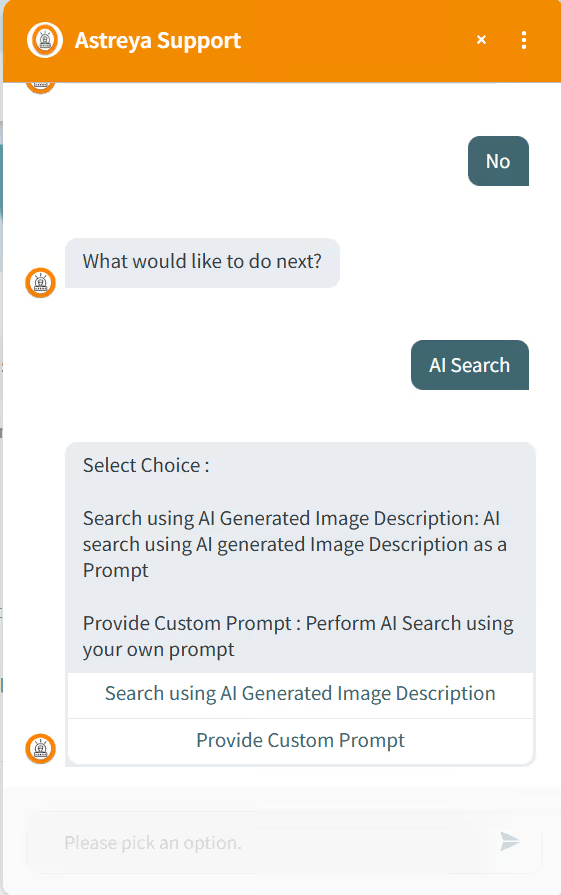
These 5 key AI agents: Issue Image Scanner, Knowledge Base Recommender, Auto Incident Creator, and Auto-Routing are part of Astraix, an AI solution for IT self-service and incident resolution. These agents can work independently and build on one another for a complete IT support flow.
Further reading: Agentic Enterprise: How ServiceNow Is Transforming AI-Driven Operations
The lightbulb moment: A screenshot without context
During a customer design workshop, one support manager said:
“If I had a dollar for every screenshot with no explanation, I’d be rich.”
That single comment triggered the entire Astraix initiative. The team realized screenshots were a rich but underutilized source of data.
What if AI could understand what users were trying to say, just from a screenshot?
That became the foundation for screenshot interpretation and issue summarization. Today, it’s the core of how Astraix operates.
The future of enterprise AI: From assistants to agents
Most enterprise tools stop at automation. Our AI agents go further. They reflect a broader trend in enterprise AI:
- From passive to proactive: AI isn’t just answering questions, it’s taking action.
- From rules to intelligence: Context-aware agents can interpret visuals and intent.
- From conventional chatbot to digital colleagues: Tools can support and enhance human teams.
Multimodal AI, like Astraix, shows us where things are heading: an AI that sees, reads, interprets, routes, and resolves, all within a single conversation.
How these agents stand out in the ServiceNow ecosystem
There are plenty of bots and automation tools in the ServiceNow Store. But most of them:
- Handle one part of a task
- Require structured input
- Don’t integrate across workflows
Astraix and its companions differ in three key ways:
- Multimodal Input: Can handle screenshots, natural language, and structured data.
- Full Journey Execution: From input to resolution, not just initiation.
- Predictive & Conversational: No need to know the right category or form.
“We designed them not as chatbots, but as AI coworkers.” – Vignesh V., AI Automation Lead
Unexpected lessons: Users don’t think in categories
Early testing revealed a surprising insight: users frequently submitted requests that weren’t IT-related things like HR questions, facilities problems, or general inquiries.
Multiply that by 30+ tickets a day, and yeah…you’re getting more than your lunch break back.
“We saw users submitting tickets that were about payroll issues, badge access, or where to find policy documents. It showed us that users aren’t thinking in terms of internal service categories. They just want help and they assume the AI agent knows where to send it.” – Amit Verma, ServiceNow MVP
This behavior highlighted a risk: misrouted tickets flooding the IT queue, wasting time and confusing users.
To solve this, the team designed domain guardrails within Astraix. These filters analyze the content of the screenshot and the text input to determine whether the issue falls within the IT domain.
If not, Astraix gracefully stops the process, often suggesting the correct channel or clarifying next steps.
“That one adjustment saved teams from chasing down issues they could never solve. It kept the experience focused and made support feel smarter, not just automated.” – Amit Verma, ServiceNow MVP
By building intelligence around what not to respond to, Astraix improved not just speed, but accuracy and user trust.
Further reading: Dark Data: The Hidden Driver Behind AI and Automation Success
Under the hood: The elegance of end-to-end support
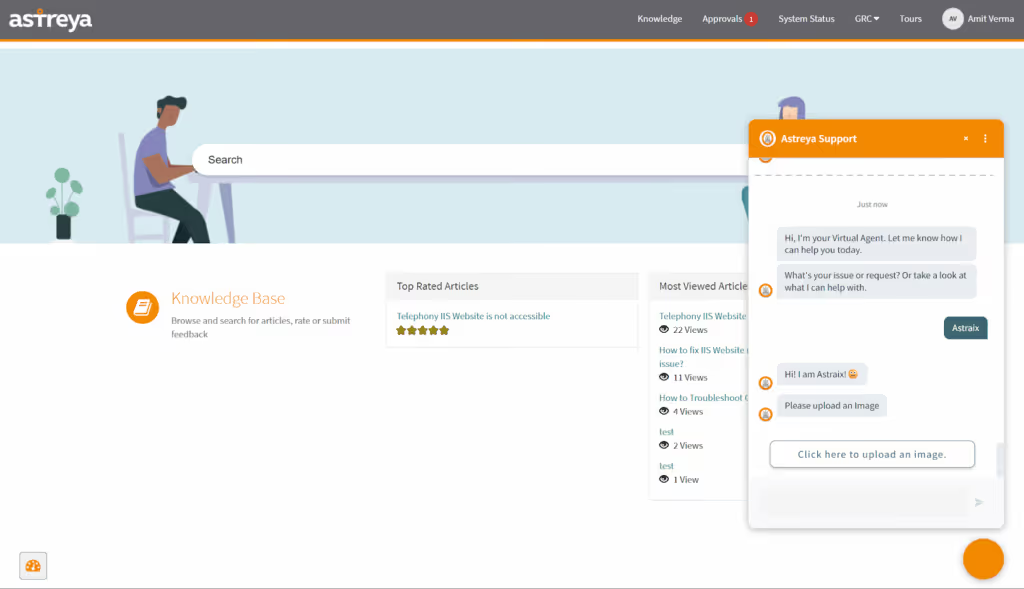
On the surface, interacting with Astraix feels simple, like a quick chat that ends with your IT problem being solved. But beneath that seamless experience is a sophisticated orchestration of AI capabilities working in concert.
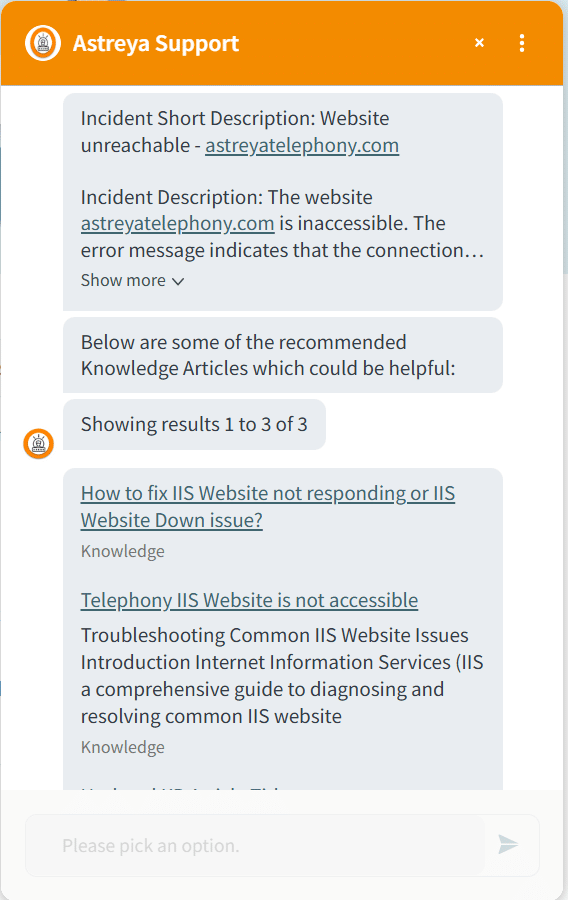
When a user submits a screenshot, Astraix immediately processes it using Google Gemini’s vision-language model, a multimodal AI that can extract error messages, recognize UI elements, and understand system states embedded in the image.
Next, a language model steps in to summarize the issue clearly and concisely, translating visual cues and vague user inputs into structured information.
From there, Astraix consults the knowledge base, offering the most relevant articles that could help the user self-resolve.
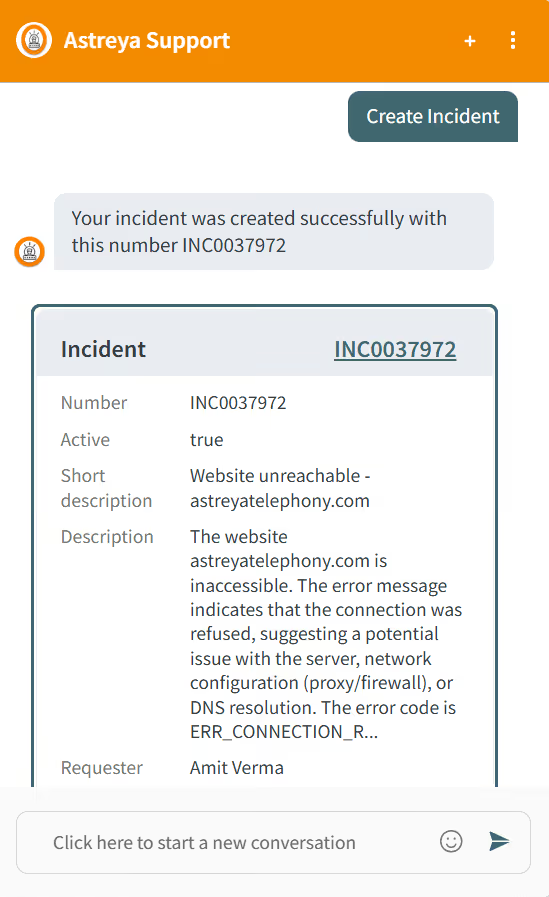
If no resolution is found, the AI agent automatically creates a ServiceNow incident and intelligently routes it to the appropriate support group using predictive analytics.
The right engineer is selected based on past performance, availability, and issue type, all without manual triage or escalation.
“The elegance is in what you don’t see. It just works.” – Debashree Chatterjee, Head of Enterprise AI
That’s the power of Astraix: transforming a chaotic, manual workflow into a coordinated, invisible engine that accelerates time to resolution while keeping the user experience effortless.
Further reading: Why Most Service Desks Are Still Broken—And What You Can Do About It
The AI agent that will quietly save thousands of hours
Another AI solution our team created is Attachments Summarizer.
It helps support teams with the time-consuming review of attachments. Its two key AI agents are Attachment Reader and Resolution Recommender.
How it works: The AI reads attachments (png, txt, PDF, and other formats), distills the key points, and can even update ServiceNow Worknotes. Attachments Summarizer even surfaces the most relevant knowledge articles so your team can act without spending ours going through pages of content.
On the surface, it may seem small, but in environments where documentation is critical, it offers many benefits:
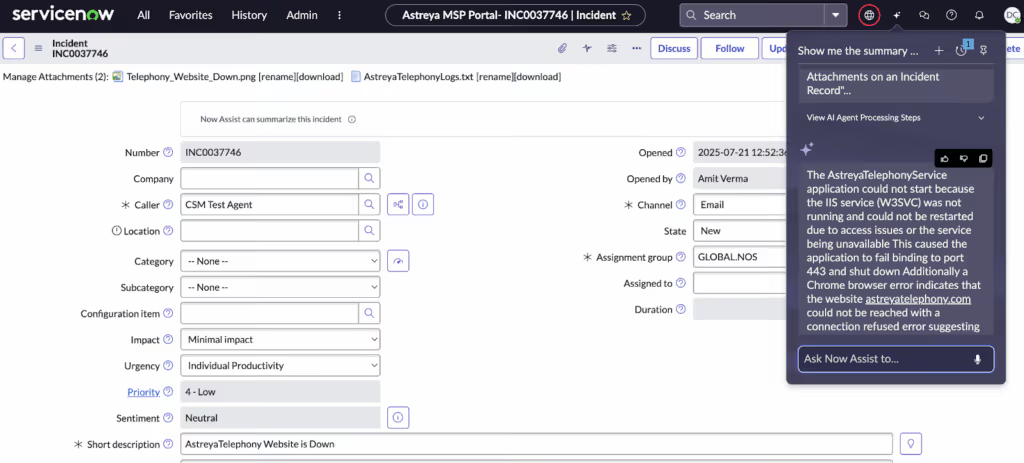
- Converts images to structured summaries
- Eliminates hours of manual input
- Increases accuracy in regulated industries
“It’s the sleeper hit. Everyone underestimates it until they use it.” – Vignesh V., AI Automation Lead
Further reading:
Technical challenges that became breakthroughs
One of the biggest challenges in building Astraix was enabling the AI to accurately interpret screenshots, a notoriously difficult input type.
Screenshots vary widely depending on the operating system (Windows, macOS, Linux), language settings, UI design, and how errors are visually presented.
For instance, a password error in a banking app looks nothing like one in enterprise software. When users upload cropped, low-resolution, or blurry images, the complexity multiplies.
To address this, our team developed a custom pipeline that leverages Google Gemini’s vision capabilities, OCR (optical character recognition), and advanced pattern recognition.
However, Gemini models are governed by tightly scoped prompts, specifically designed to focus on IT-related issues. This constraint ensures precision but also demands highly contextual inputs. This gave the system the contextual grounding it needed to recognize subtle visual cues and accurately classify the type of IT issue.
The result is Astraix: an AI agent capable of diagnosing a wide range of IT problems directly from an image. Whether it’s a proxy error, a failed login screen, or a password reset loop, the AI solution interprets visual data, identifies the issue, and routes it to the right support team member.
From workflow engine to AI powerhouse
One of the unexpected discoveries during the development process for our customer was just how flexible and extensible the ServiceNow platform truly is.
While many think of ServiceNow primarily as a workflow engine or IT service management tool, the team quickly realized it offers far more, especially when building and scaling AI-driven solutions.
ServiceNow’s seamless integration capabilities allowed the team to connect external tools like Google Gemini without friction. This opened the door to building advanced multimodal capabilities, such as image interpretation and contextual understanding, directly within the ServiceNow environment.
Flow Designer became an essential tool in automating agent responses and routing. Its no-code interface helped our team move quickly and standardize how different inputs (like screenshots or typed queries) were processed.
By layering Predictive Intelligence on top, we could incorporate machine learning models that helped with issue classification, prioritization, and smarter decision-making without needing to leave the platform.
One of the biggest wins in this project was how quickly we could test and launch new ideas. Using ServiceNow’s Virtual Agent, our team built conversational experiences that we improved in real-time based on live feedback. This helped our client move from idea to execution much faster.
We also helped them bring in large language models (LLMs), even without Now Assist. By adding these AI features into the Virtual Agent, we gave them a fast way to start using AI-powered service. They didn’t need the full ServiceNow suite to see results. This is just one way we help clients get more from the tools they already have by building smart, flexible solutions based on where they are today.
Use Case: Solving inefficient & inconsistent IT issues with multimodal AI
What business problem was the customer trying to solve with conversational AI?
Our customer was dealing with inefficient and inconsistent IT issue reporting and resolution. Traditional channels often required users to describe technical problems manually, leading to vague tickets, delays in triage, and misrouted incidents.
With Astraix, the goal was to create a conversational, screenshot-driven channel that simplifies how users engage with IT support. By automating issue understanding, knowledge recommendations, incident creation, and intelligent routing, Astraix helps reduce resolution time, improve accuracy, and enhance the overall support experience while ensuring the focus remains strictly on IT-related issues.
Why did they need a rapid prototyping approach?
Our customer needed a rapid prototyping approach to quickly validate real-world use cases and ensure the AI agent aligned with user expectations across diverse IT environments. Given the complexity of screenshot interpretation, intelligent routing, and knowledge recommendations, early iterations and feedback loops were essential.
Rapid prototyping allowed us to test, refine, and adapt Astraix’s capabilities based on actual user behavior,ensuring the solution was not only technically sound but also intuitive, scalable, and aligned with business goals from day one.
What did Astreya do that went beyond the out-of-the-box ServiceNow Virtual Agent?
Astreya extended the out-of-the-box Virtual Agent by transforming it into a multimodal AI agent capable of managing the entire IT support lifecycle.
Unlike standard Virtual Agent setups that rely on static dialogs and manual inputs, Astraix uses Google Gemini to analyze screenshots, generate contextual summaries, surface relevant knowledge articles, and perform AI-powered search—all within a single, seamless conversation.
What truly sets Astraix apart is its ability to understand issues directly from images, recommend the right knowledge articles and AI agents, and automate both incident creation and intelligent assignment. By combining ServiceNow Predictive Intelligence with custom routing algorithms, Astraix doesn’t just assist, it resolves. It acts as an intelligent gateway, closing the loop from issue detection to resolution without human intervention.
Did Astreya design conversation flows, train models, and configure integrations?
The development of Astraix followed a full-spectrum design approach. We:
- Designed custom conversation flows specifically for screenshot-based issue reporting, ensuring a natural and intuitive user experience.
- Configured integrations with Google Gemini to enable multimodal AI capabilities—allowing the agent to interpret images and generate contextual summaries.
- Leveraged and fine-tuned ServiceNow Predictive Intelligence to support intelligent incident routing and assignment.
- While we didn’t train foundational models from scratch, we optimized AI behavior using prompt engineering, guardrails, and contextual tuning to deliver accurate, IT-specific support.
This holistic approach ensured Astraix goes far beyond standard chatbot functionality, offering a truly intelligent, end-to-end support experience.
What decisions or behaviors changed because of the virtual agent rollout?
End users stopped logging tickets the old-fashioned way and began using a more conversational, screenshot-based approach. This made support feel easier and more natural. Support teams saw fewer repetitive questions, thanks to accurate knowledge article suggestions and AI-powered self-service. Additionally, smart routing and predictive assignment sped up incident handling, helping teams triage and resolve issues faster. Overall, Astraix made support more proactive, efficient, and user-friendly.
“It’s more than a workflow engine. It’s an AI platform in disguise. What started as a tool for IT support quickly grew into a smart, adaptable system. Thanks to ServiceNow’s built-in capabilities, we were able to create AI-powered agents that learn, improve, and scale using features they hadn’t originally planned to depend on so heavily.” – Debashree Chatterjee, Head of Enterprise AI Services
Built with (and for) support teams
These agents weren’t just built by engineers, they were shaped by the people on the front lines of IT support. From the start, our team worked closely with internal support staff, enterprise customers, and global IT departments.
Through hands-on design reviews, usability testing, and continuous feedback from real users, every feature of Astraix was built to reflect how support teams actually work.
The result? Agents that feel less like tools and more like informed teammates.
Who benefits most?
While any IT operation team can benefit from this AI agent suite, a few industries stand to gain the most:
- Financial Services: High compliance, high urgency
- Healthcare & Life Sciences: Dense attachments, mission-critical workflows
- Manufacturing & Engineering: Screenshot-heavy issue reporting from specialized systems
Final Word: The future is resolution-first
The future lies in agents that understand real problems, take the right action based on context, and keep learning to get better.
Our AI Agents go beyond basic automation, they offer a glimpse into what IT support can be: smooth, fast, and easy to use.