


.jpg)

Blog//
Experience Level Agreements and the Rise of Digital Employee Experience
October 8, 2026
October 6, 2026

Digital Employee Experience (DEX) refers to how employees interact with and experience technology in their daily work. Experience Level Agreements (XLAs) create the contractual framework that holds IT services accountable for that experience. XLAs are an extension of traditional Service Level Agreements (SLAs). Where SLAs ask, “Was this thing delivered?” XLAs ask, “Did this thing help?”
Why are organizations prioritizing DEX?
The goal of DEX is to make daily work smoother and more personalized for the workforce. A DEX strategy shifts IT support’s focus from the systems people use to the people using them.
Organizations are prioritizing DEX to:
- Move from a reactive support to a proactive support model
- Reduce the high cost of IT friction across multiple workplace tools used every day — according to WalkMe, an SAP company, enterprises lose 51 workdays per employee every year due to technology friction.
- Adapt to remote and hybrid work environments where digital interactions serve as the primary method of IT support
- Retain top talent and maintain high employee engagement by delivering frictionless digital experiences
How do XLAs measure DEX?
Where SLAs track operational numbers like ticket volume, XLAs measure how employees experience IT support. How easy was it to get the help you needed? How quickly were you able to return to work?
Common XLAs metrics
- Customer Effort Score (CES): Measures how easy or difficult it is for the user to resolve an IT issue, complete a request, get help from IT staff or automated tools like chatbots
- Sentiment and polarity from micro-surveys and ticket language: Uses natural language processing (NLP) metrics to analyze the emotional tone of end-user feedback on a scale from strongly negative to strongly positive, offering a qualitative measure superior to traditional CSAT numbers
- Time-to-Productivity-Restored: Measures how long a user was unable to work, from when a problem starts to when the user is fully back up and running. Not to be confused with “ticket-close speed”; tickets may close before an employee is able to return to work.
- First Contact Resolution (FCR) as an experience metric: Evaluates first-turn resolution from the user's perspective of satisfaction rather than as a purely operational metric — did the user feel the issue was solved on the first attempt?
Why can’t SLAs alone measure experience?
SLAs alone fall short of capturing the full picture of user experience because they only evaluate operational metrics like ticket volume and response speed. XLAs, on the other hand, measure how IT services directly impact employee engagement, productivity, sentiment, and satisfaction.
One problem with relying on SLAs alone is the “watermelon effect.” A typical SLA dashboard looks green on the outside because IT meets operational targets, but remains red on the inside because users feel frustrated and unproductive. For example, when a user requests a password reset, an automated system sends a link and closes the ticket, logging an SLA success.
However, if the new password fails to sync with the user's mobile VPN, they must reopen multiple support tickets over several days. While the SLA registers success, the XLA exposes the productivity loss and frustration experienced by the user.
How do you implement XLAs?
- Gather baseline current experience: Voice of the Customer (VoC) data, CES, and sentiment metrics
- Select core experience metrics: Pick 3–5 key experience metrics that are tightly linked to strategic business outcomes, such as loss of productivity
- Instrument measurement tools: Deploy micro-surveys and proactive endpoint telemetry to capture continuous data
- Establish governance cadences: Review experience metrics regularly in weekly operations meetings, Monthly Operational Reviews (MORs), and Quarterly Business Reviews (QBRs)
- Iterate and automate: Feed operational findings directly into your automation roadmap to eliminate recurring friction points
How AI makes DEX measurable at scale
Artificial intelligence transforms DEX measurement from reactive tracking into proactive optimization. AI tools, such as ServiceNow certified AI agents, use data from micro-surveys and telemetry to contact users about issues before those users raise tickets. They can also recognize patterns across ticket logs and automatically generate knowledge resources to close recurring friction points.
Josh Spring, Service Desk Practice Lead at Astreya, notes that AI enhances this process at scale:
"In DEX, AI adds value by correlating telemetry, detecting anomalies, and synthesizing root causes with researched precision. Without it, support teams burn valuable time through logs or rely heavily on static thresholds; meaning we often wait for a major failure rather than catching a subtle deviation from normal behavior. AI enables real-time analysis so we can follow leading indicators and act proactively."
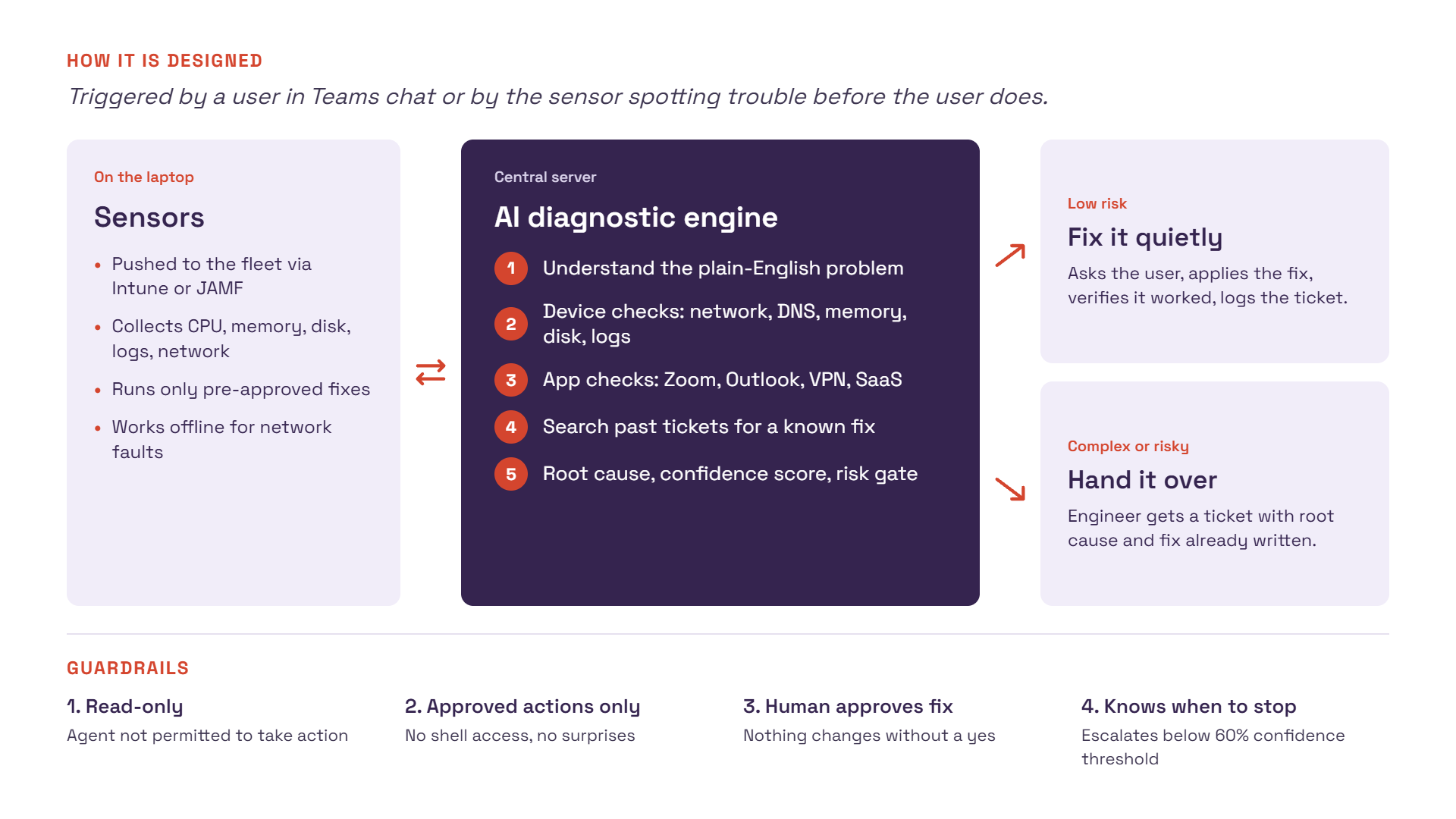
Learn more about a specific AI application in the Astreya webinar, Voice AI for the IT Service Desk: How It Works in ServiceNow.
Frequently Asked Questions (FAQ)
What’s next?
Ready to eliminate the watermelon effect and measure what truly matters to your workforce? Explore our Service Desk Solutions and learn how Astreya transforms IT support into a frictionless driver of employee productivity.
Frequently Asked Questions
What does DEX stand for in IT?
DEX stands for Digital Employee Experience, which measures how employees experience and interact with workplace technology, applications, and support services.
Is an XLA a replacement for an SLA?
No. An XLA does not replace an SLA. XLAs complement traditional SLAs by linking operational performance targets to real user sentiment and experience outcomes.
What tools measure digital employee experience (DEX)?
Organizations measure DEX using endpoint telemetry platforms (Tanium, Nexthink, Lakeside Software, etc.), micro-survey tools, natural language processing (NLP) sentiment analytics, and AI-driven service desk management platforms.
Who owns DEX in an organization?
DEX ownership typically spans cross-functional leadership, including End-User Computing (EUC) leads, IT Service Management (ITSM), IT Operations, Chief Information Officers (CIOs), and Chief Human Resources Officers (CHROs).