

.jpg)

Blog//
The Limits of IT Automation and the Rise of Agentic AI
August 17, 2026
February 28, 2026

For decades, IT operations have relied on automation to keep systems running. Scripts to provision infrastructure, workflows to route tickets, jobs to patch and back up environments at scale. These rule-based automations worked well when change was predictable, but today’s environments shift too quickly for static rules.
IT teams need a more flexible approach, and agentic AI may be the answer.
Why IT operations need agentic AI now
Traditional AI is effective for deterministic tasks like classifying alerts and detecting anomalies. It can even support system interpretation and root-cause analysis. But in real IT operations, work rarely stays in one system and conditions don’t stay the same for long. When incidents occur, they often involve multiple domains and require coordination that fixed automation struggles to handle.
Agentic AI, however, was built for just this.
For example, license reclamation in Service Desk operations involves thousands of users and spans collaboration tools, project management platforms, SaaS applications, and identity systems. Traditional automation can send reminders and generate reports, but it can’t reason about usage patterns, employment status changes, or evolving project needs to decide when action is appropriate.
Agentic AI works with usage data, identity and HR signals, policy rules, and service constraints to understand what’s happening and what should happen next. It determines whether a license is still needed, reclaims or reassigns it when conditions are met, and escalates only when policy or risk thresholds are crossed. Specialized agents can monitor usage, enforce policy, or coordinate access, carrying decisions end to end and involving humans only when judgment or exception handling is required.
Agentic AI is built on existing automation
IT automation has evolved to address a series of practical limitations. Runbooks handled repetitive tasks but were rigid. ITPA improved coordination across workflows, though it still relied on predefined logic. RPA and chatbots expanded automation into more systems and interfaces, using natural language to make interactions easier—but adaptability and reasoning remained limited.
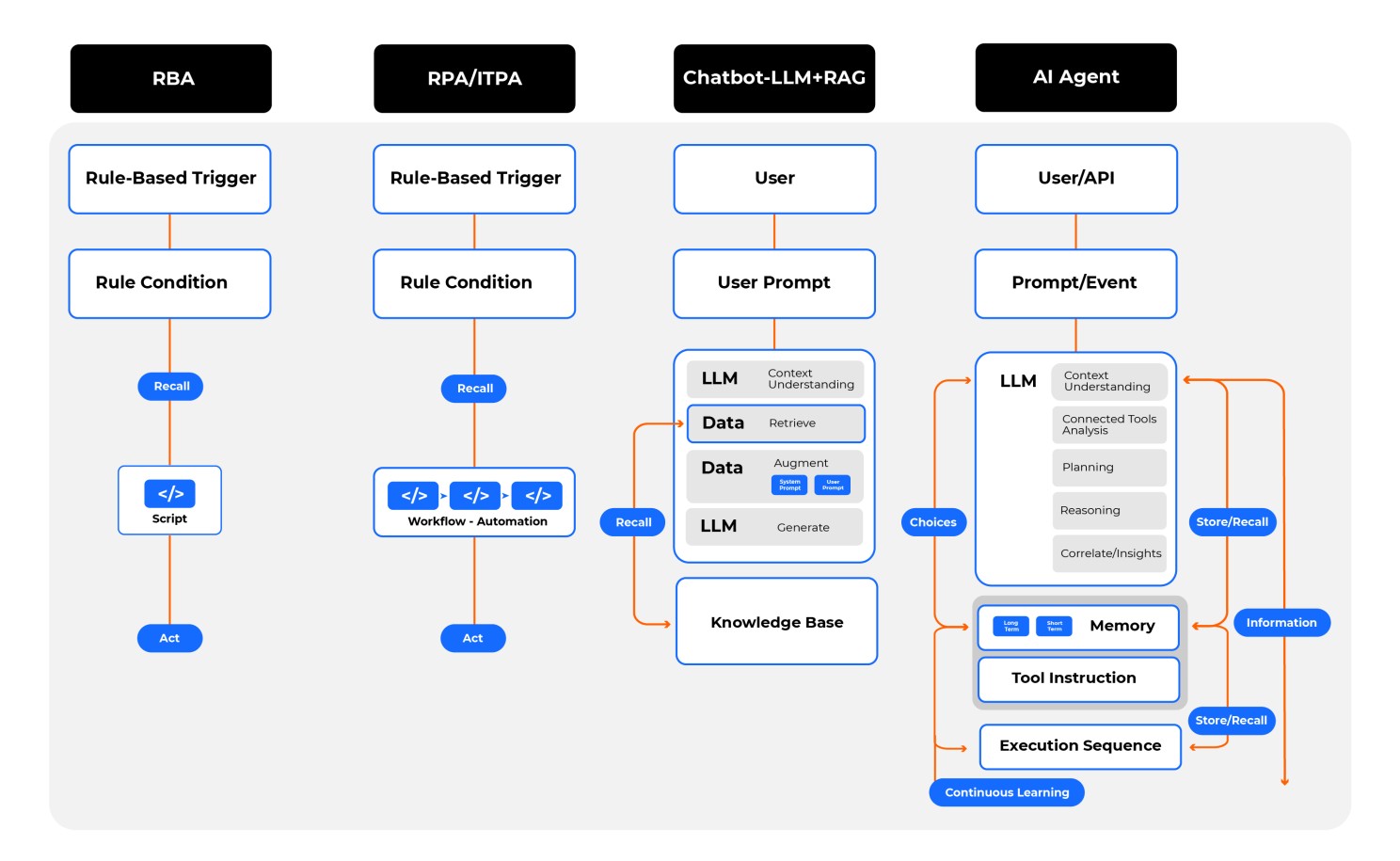
These technologies form an ecosystem many organizations already use in pieces. The challenge is that most operate independently, without shared context or coordinated decision-making. Understanding what each capability adds and where it stops short helps explain why automation has struggled to become truly adaptive at scale.
Agentic AI represents the next shift. Rather than automating tasks in isolation, it orchestrates multiple specialized agents that share context, reason together, and act across systems. This architectural change—from isolated execution to coordinated intelligence—is what defines agentic IT operations.
How agentic AI coordinates decisions across systems
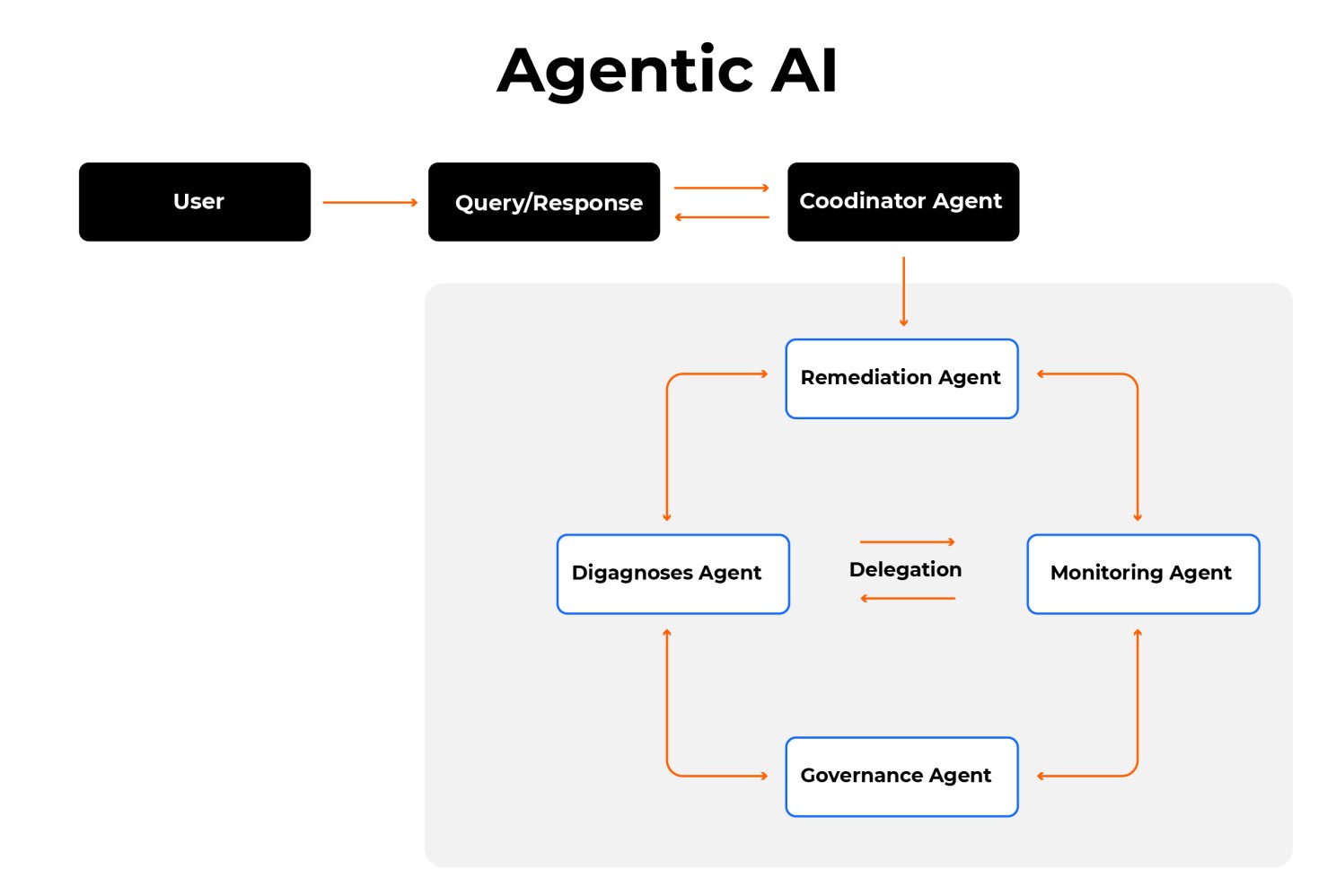
Agentic AI systems rarely rely on a single agent. Instead, they coordinate multiple specialized agents, each responsible for a specific aspect of the problem, such as diagnosis, remediation, monitoring, or governance.
A coordinating agent maintains shared context and delegates work across these agents as conditions change. Agents can hand off tasks, validate each other’s outputs, and escalate issues when policies or risk thresholds are reached. This allows the system to resolve complex issues collaboratively, rather than treating them as isolated tasks.
The diagram below illustrates how a coordinator agent directs specialized agents to diagnose issues, apply remediation, monitor outcomes, and enforce governance, mirroring how human teams coordinate across roles.
How to build agentic systems from existing automation
Most organizations already have pieces of an agentic system in place: event streams, APIs, workflow engines, monitoring tools, policy rules, and years of embedded automation across ITSM, cloud, and security platforms. What’s often missing is the structure that allows those components to work together.
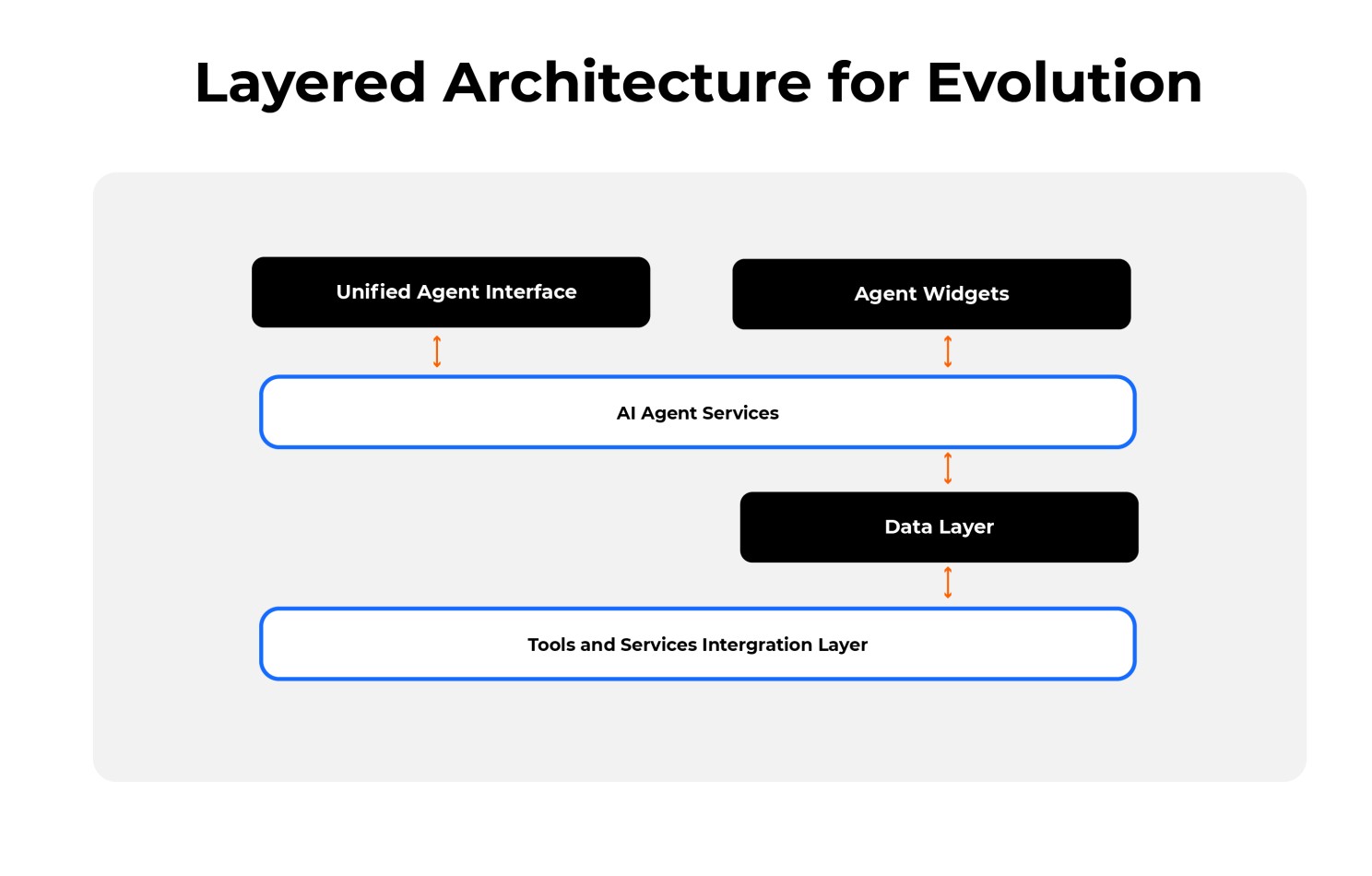
Agentic AI depends on four layers working together:
Operational tool integration. Agents connect to ITSM platforms, monitoring systems, and automation workflows so they can observe real events and take approved action.
Unified data foundation. Shared, normalized data provides consistent context across systems, allowing agents to reason about impact rather than reacting to isolated signals.
Agent services. Defined agent roles and boundaries govern how agents reason, coordinate, and act, keeping decision logic understandable and controlled.
Human interface and oversight. Interfaces give teams visibility into agent behavior and the ability to guide, approve, or intervene as agents operate in production environments.
When these layers are designed together, agents can see what’s happening, understand why it matters, act safely, and remain accountable as they scale. When they are loosely connected, agent behavior becomes brittle, opaque, or risky, which limits use to low-impact scenarios.
This blueprint helps teams organize existing capabilities so agentic systems can evolve predictably, deliver value beyond isolated automations, and remain under human control as complexity grows.
Assessing and scaling agentic AI in IT operations
Moving to agentic AI is a progression. Organizations that succeed start by assessing where they are today, which use cases matter most, and what foundations need strengthening before scaling. Without that clarity, AI initiatives stall, fragment, or fail to deliver value.
To support organizations at different stages, Astreya offers assessment options that evaluate the same core readiness dimensions, with increasing depth and specificity.
Rapid Assessment
The Rapid Assessment adds structure and validation. Delivered over two weeks, it focuses on readiness scoring, near-term opportunities, and executive-level recommendations to support investment decisions.
Rapid Plus Assessment
For organizations that need clearer direction, the Rapid Plus Assessment goes further—evaluating priority domains, identifying platform and capability gaps, and producing a short-term roadmap aimed at demonstrating measurable impact within six months.
Detailed Assessment
The Detailed Assessment supports organizations ready for full-scale transformation. It provides deep, domain-level analysis and a phased roadmap spanning 6 to 36 months, aligning agentic AI initiatives with business outcomes, governance, and long-term scale.
Together, these options offer a practical path from initial orientation to confident execution without overcommitting too early or underinvesting when readiness is already there.
What it takes to make agentic AI work
IT operations have reached an inflection point where traditional automation can no longer keep pace with modern complexity. The future belongs to agentic AI systems that work like human teams to understand context, coordinate actions, and resolve issues end to end.
This transformation is a journey, not a one-time deployment. Success depends on understanding where you are today, prioritizing the right use cases, and building capabilities that scale over time. A holistic readiness and maturity assessment is the first step, aligning strategy, technology, data, processes, people, and governance. From there, teams can build a sturdy agentic AI system that allows IT to support business change without becoming a bottleneck or cost amplifier.
Ready to begin your agentic AI journey?
Get in touch with a certified AI expert.