


.jpg)

Blog//
Active Metadata as the Operating System for Enterprise AI
August 20, 2026
March 23, 2026

AI depends on metadata, but not all metadata is fit for the job. Despite $30–40 billion in enterprise investment in generative AI, MIT research shows that 95% of organizations have no measurable return to show for it. The gap isn't explained by model quality or regulation. It comes down to approach. And one of the most common points of failure in that approach is metadata.
Metadata practices designed before AI workflows existed were not built for systems that change continuously. In most organizations, metadata is fragmented across platforms and out of sync because manual updates cannot keep pace with how fast systems actually move. As a result, AI behaves inconsistently, even when the models underneath perform well.
To build AI programs that deliver, organizations need active metadata that keeps up with their systems. They also need to start treating metadata less like a catalog and more like an operating system.
Why metadata should function as an OS
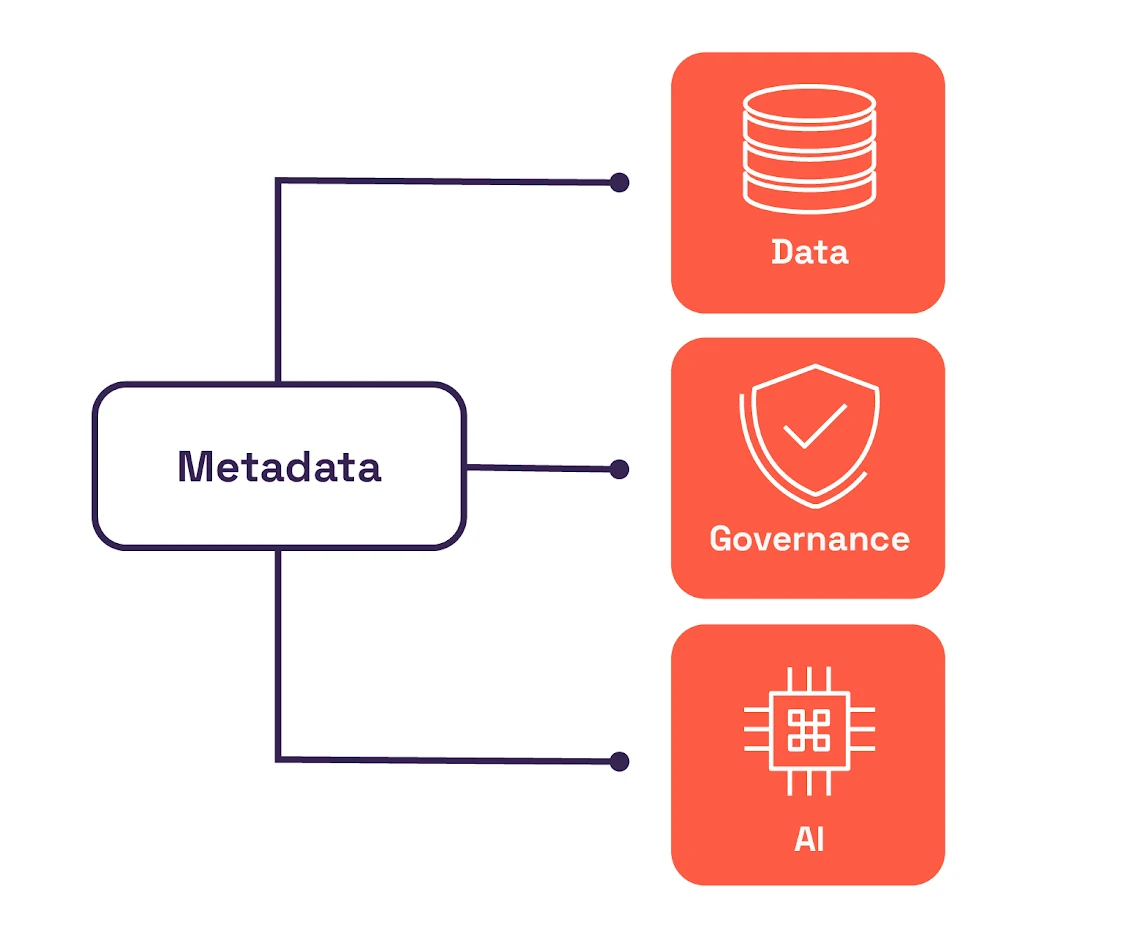
An operating system manages interaction. It governs how applications access resources, enforces shared rules, and keeps different components operating within consistent constraints. Metadata can serve the same coordinating function for AI across the enterprise, forming what amounts to a metadata operating system within modern data architecture.
For example, when an AI agent requests data for analysis, metadata functioning as an OS can determine which datasets are appropriate for that task, enforce the relevant access and compliance rules, and provide context about freshness and reliability before the data is consumed. That coordination happens consistently across tools and workflows rather than being rebuilt inside each platform.
Metadata that refreshes based on real-time system activity, including queries, lineage changes, data quality signals, and model usage, gives AI the context it needs to operate reliably. It becomes a control layer that shapes how AI systems interpret data, apply rules, and arrive at decisions, enabling stronger AI governance and organizational readiness.
Because this metadata updates as systems run, its value extends well past documentation. Context stays current as data changes. Governance rules get enforced consistently at runtime. AI systems gain a dependable mechanism for evaluating relevance, trust, and constraints before data enters a workflow.
How to make the shift
1) From Static to Active Metadata. This is a technical and operational change, not a tooling overhaul. The shift starts when teams change who is responsible for updating metadata and when those updates occur.
With static metadata, engineers, analysts, or data owners update catalogs after changes have already happened. That documentation almost always trails reality. With active metadata, platform and data engineering teams wire their systems so that metadata updates are a byproduct of normal execution, producing real-time metadata rather than periodic snapshots.
For example, instead of asking engineers to record lineage by hand in a data catalog, teams configure pipeline tools to emit input-output relationships each time a job runs. Those relationships write to a shared metadata store and become the authoritative record. When a pipeline changes, lineage updates automatically because execution changed. No one needs to edit documentation.
The same principle applies to usage tracking and freshness. Instead of relying on scheduled reviews or manual flags, teams derive usage from query logs and tie freshness directly to job schedules and completion outcomes. Relevance and freshness reflect what systems actually do, not what someone last recorded. This is the foundational step toward runtime metadata management.
2) From Active Metadata to a Metadata OS. Once metadata updates reliably based on system behavior, the next step is using it to coordinate decisions across platforms.
In most environments, decisions about access, policy enforcement, and automation are embedded separately inside each tool. With active metadata, teams can consolidate those decisions into a shared layer, defining rules, thresholds, and trust signals once and referencing them consistently wherever decisions need to be made. This is the core of metadata-driven automation.
For example, instead of hard-coding access rules into individual platforms, teams reference shared metadata signals such as sensitivity classification, usage context, and data ownership to determine whether an AI agent, workflow, or user should be granted access. The agent doesn't need custom guardrails built into the model. It follows the same metadata-governed rules as every other consumer of that data, improving governance across generative AI and providing richer context to AI models.
When something changes upstream, a schema modification or a failed pipeline, metadata can surface which dashboards, models, or workflows depend on the affected data. Teams learn what's impacted before users report problems. This is an essential capability for managing enterprise metadata at scale.
Metadata does not execute workflows or replace existing systems. It becomes the place where context is evaluated and decisions are governed. Systems still act. Metadata determines when, how, and under what constraints those actions proceed.
Along the way, work with teams to reframe how they think about metadata. Treat it as operational intelligence, not a catalog entry or a compliance artifact. Position it as a system of signals that governs how data and AI work together day to day. That framing makes it easier to support the technical and architectural changes required to scale AI in a controlled, predictable way.
Common obstacles in the transition
Most metadata strategies break down when they reach operational IT data. Many approaches are designed for analytics, BI, or ML pipelines, but the real friction appears in systems like ITAM, ITSM, and employee data, where ownership is distributed and data ties directly to operational actions. These environments expose structural gaps and missing shared definitions that cleaner data domains tend to mask.
Raw fields don't translate into decision-ready context on their own. Operational systems produce enormous volumes of data, but that data isn't organized around the decisions teams need to make. Fields exist in isolation. Relationships remain implicit. Signals don't align clearly enough to assess health, risk, or downstream impact. Activating metadata without resolving this structural deficit generates more activity without producing better insight.
Activating metadata amplifies inconsistency rather than resolving it. As metadata updates more frequently, differences in naming conventions, definitions, and assumptions across systems become impossible to ignore. The same concept shows up in slightly different forms across tools, and active metadata exposes those mismatches rather than papering over them. Without intentional alignment, metadata cannot coordinate behavior effectively.
Point solutions don't generalize. Teams can solve problems within a single domain using custom logic or manual correlations, but those approaches collapse as scope expands. Without a repeatable method for assessing and organizing metadata across domains, efforts plateau before metadata can function as a broader coordination layer.
These obstacles tend to appear together, especially in operational IT environments. That combination makes it difficult to scope what matters, maintain consistent meaning across tools, and build metadata into something systems can depend on.
A consistent framework: DIKI
Rather than activating everything and hoping insight emerges, the DIKI framework (Data, Information, Knowledge, Insight) provides a clear progression from raw fields to action. It helps teams control scope, enforce consistency, and make metadata usable for AI in practice:
- Data: Be selective about which raw fields matter for a given decision rather than trying to activate everything at once.
- Information: Group related fields and normalize them so they describe something concrete, such as an asset or a service, instead of remaining scattered across systems with no shared structure.
- Knowledge: Patterns and relationships become visible and consistent across systems, enabling the same concepts to be understood the same way wherever they appear.
- Insight: Shared context supports action, whether that means prioritizing refresh decisions, triggering ITSM workflows, or flagging risk, without depending on manual interpretation at each step.
Astreya uses the DIKI approach to turn raw metadata into context that teams can act on immediately. For example, by organizing fields such as device age, warranty dates, utilization metrics, and incident history, we produce a clear picture of device health. That structure reveals patterns like aging assets with recurring performance issues, which support proactive refresh decisions and automated ITSM actions.
The value of this approach is its repeatability. DIKI provides a consistent method for assessing IT datasets, surfacing meaningful relationships, and identifying automation opportunities. Over time, this reduces effort, accelerates insight generation, and gives organizations a dependable path from fragmented metadata to intelligence-driven outcomes.
Reliable AI starts with active metadata
Most AI programs stall because metadata cannot provide reliable, shared context at runtime. Active metadata, treated as an operating system, is what allows AI to scale with governance, coordination, and trust intact.
Many of the teams we work with are investing heavily in AI and struggling to make it operational. If that describes your situation, we would welcome the chance to help you assess whether your metadata is functioning as an operating layer or holding your AI initiatives back.
If your AI programs are stalling, the issue may be the metadata.
Contact us at Astreya to evaluate whether your data and metadata foundation is positioned to support reliable, scalable AI.