

.jpg)

Blog//
IT Asset Lifecycle Management: Stop Waste, Boost ROI
August 20, 2026
February 6, 2025

Table of Contents
- The importance of IT asset lifecycle management
- IT lifecycle management stages
- Planning: Setting the foundation for operational success
- Acquisition: Making informed choices for long-term efficiency
- Operation: Maximizing asset performance
- Maintenance: Extending asset lifespan & optimizing costs
- Reverse logistics: Closing the loop
- Success stories: Real-world impact of IT lifecycle management
- Key benefits of IT asset lifecycle management
Key takeaways
- Stop the IT chaos. A structured strategy means no wasted money, lost assets, and less downtime.
- Plan ahead, save big. Forecasting your IT needs = no more last-minute, overpriced panic buys.
- Vendor relationships matter. Strong partnerships = better deals, warranties, and VIP-level support.
- No more surprise meltdowns. Preventive maintenance keeps things running smoothly; no panic buttons needed.
- AI’s making things easier. Smart monitoring catches failures before they turn into costly disasters.
- Growth-ready, future-proofed. A solid IT asset lifecycle strategy keeps you scaling, automating, and ready for what’s next.
- ITAM = your money’s worth. Every dollar spent works for you and helps IT and business align their investments toward their goals.
When you think about IT asset lifecycle management, what’s the first thing that comes to mind?
For some, it’s an early example—railroads—overseeing train cars, managing maintenance schedules, and keeping operations on track.
Fast forward to 2025, and the same principles apply, but now we’re talking about IT assets like laptops, servers, and hardware.
But the goal remains the same:
- stay organized,
- minimize waste,
- keep everything running smoothly.
It’s like a trip to the grocery store.
Some of us go in with a list, knowing what we need and where to find it.
Others? Wing it. They haven’t checked the fridge, don’t know what’s expired, and might end up buying a third bottle of ketchup while forgetting the eggs.
Without IT asset management, businesses can look like that second shopper—disorganized, wasteful, and spending money on things they don’t need while losing track of what they already have.
But with a solid system in place, IT asset management transforms how you operate. You’ll know what assets you have, where they are, and how they’re performing.
In the next section, we’ll dig into the different stages of IT Asset Lifecycle Management (ITAM) and how Astreya’s best practices can help you keep organized and save money.
At Astreya, we break down the IT lifecycle management process into the following stages:
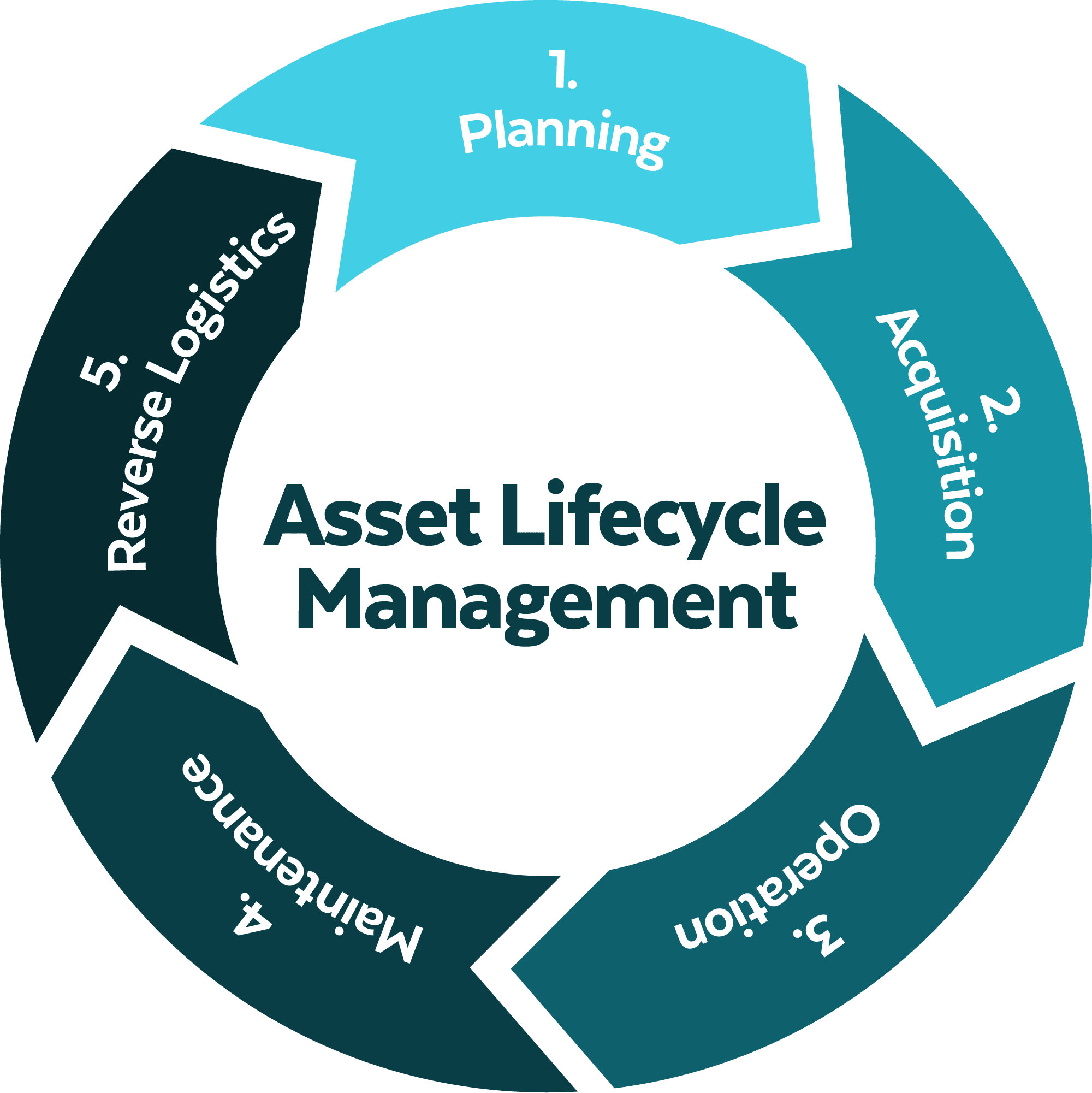
- Planning
- Acquisition
- Operation
- Maintenance
- Reverse Logistics
Next, we’ll dissect each stage of ITAM Lifecycle to show you how to reap the most benefits.
So, let’s get tactical with IT logistics.
You’ve probably heard the saying, “Failing to plan is planning to fail.”
The Planning phase of IT lifecycle management is designed to set you up for success now and in the future. It intends to help you meet your current demands, better integrate with your existing systems, and adapt more seamlessly to change.
At Astreya, we start with an audit—or an overview of our customers’ existing IT assets. The audit gives us a window into their assets’ current state, providing insights into asset use, performance, and end-of-life timelines.
But it doesn’t end there. Forecasting your IT needs is just as important as the audit.
To jumpstart your thinking, consider these questions:
- How is our company expanding?
- Are we experiencing employee growth?
- Do we anticipate an increase in workloads?
- Are we investing in emerging technologies like AI, IoT, and automation?
- Are we meeting industry standards such as GDPR, HIPAA, and ISO 27001?
Keep in mind, these questions just scratch the surface of the planning stage, but they illustrate the strategic thinking we guide our customers through.
If you’re interested, speak to our expert asset lifecycle management experts.
Aligning IT asset strategies with organizational goals
Once you have a plan, you’ll need to ask: do the asset purchases I’m looking to make support business goals?
You’ll also need to factor in asset purchase price, maintenance support, and decommissioning costs.
“Always have a backup plan to the backup plan.” – Gillian Flynn, Gone Girl
Things can go wrong.
Naturally, we all do our best to prevent that from happening. Still, it never hurts to have a backup and disaster recovery plan. Having one and training your people on what to do if there ever is a crisis, keeps your business from grinding to a screeching halt.
Lastly, you’ll also want to build strong relationships with vendors and suppliers. Making this a priority can help you get better pricing, more generous warranties, and enhanced support.
Don’t know where to start? Our team can develop your vendor and supplier partner strategy. Learn more here.
Why planning controls minimizes surprises
What’s the cost of poor planning? Two of the most gut-wrenching consequences that make your CFO wince are:
- Emergency IT purchases with a premium price tag: When unexpected needs arise without a plan, you’re forced to make rushed decisions, often paying inflated prices for quick fixes.
- Having too many IT assets or having a shortage: If you buy too much, you’ve spent money on things you aren’t using. They will likely collect dust in a corner and be out of date when someone needs them. The other side of the coin? Underestimating leads to frustrating bottlenecks and stifled productivity.
There’s a bright side.
Creating and implementing a solid IT lifecycle management plan helps you dodge these pesky headaches and stay flexible in today’s ever-changing tech world.
Acquisition, the second phase of IT Asset Lifecycle Management, involves selecting, purchasing, and integrating hardware, software, and services into your technology ecosystem.
At Astreya, we go beyond procurement logistics—we help our clients select IT assets that align with their business needs while navigating complex IT ecosystems. But we’re not just looking at options that maximize asset performance. Our team also looks at ways to reduce costs and enable scalability to set you up for success as your needs evolve.
Procurement, your way—with expert guidance
We understand that every company has its own procurement preferences.
For instance, you might have an existing vendor network that you want to work with. Or, you don’t have a vendor in mind and need support to help you vet and weigh your options.
Either way, working with our IT asset lifecycle management experts can give you a holistic view of your tech ecosystem and business goals, ensuring that acquisition aligns with your needs.
When picking vendors, dig deeper.
- Are they reliable?
- Do they deliver good service?
- Will they scale with you as you grow?
Look at support quality, licensing models, and security compliance—because a bad choice here can haunt you later.
What you acquire needs to mesh seamlessly with your existing IT infrastructure. The real question is: Are your choices today setting you up for automation and future-ready tech—or setting you back?
Last, but not least, cost. Don’t just focus on the sticker price—look at the total cost of ownership (TCO). That means prioritizing durable, upgradable tech that won’t become obsolete overnight.
And don’t let hidden costs sneak up on you—licenses, warranties, support contracts… are they flexible enough to grow with your business?
Asking the right questions now saves you from kicking yourself later.
Have you ever tried using a 10-year-old smartphone?
It still technically works, but it’s slow, glitchy, and frustrating, and no matter how many times you restart it, it just can’t keep up.
That’s what happens with old IT hardware.
Streamlining processes for seamless hardware usage
Managing IT hardware without a streamlined process is like trying to run a restaurant with no kitchen inventory system—things get misplaced, orders take longer, and you end up wasting money on what you don’t need while running out of what you do.
Inefficient IT hardware deployment, tracking, and maintenance leads to delays, security vulnerabilities, and budget overruns. To prevent this, you need a structured, repeatable process that gets followed.
Case study: Transforming an R&D data center for maximum efficiency
Our client, a leading R&D testing lab, faced significant operational inefficiencies that slowed productivity and pulled engineers away from high-value work.
Our IT asset management experts stepped in and transformed the lab into an agile, efficient operation by:
- Creating a centralized documentation system – Standardized labels, rack assignments, and tracking tools, enabling quick asset identification and reducing troubleshooting time.
- Optimizing custom rack deployments – Reverse-engineered assembly processes for new custom racks with no instructions, developed detailed build guides, and streamlined deployment procedures, cutting installation time and ensuring repeatability.
- Implementing a Just-in-Time (JIT) labor model – Maintained a core onsite team for daily operations while deploying reinforcements on demand during workload spikes—reducing overhead without sacrificing efficiency.
- Processing inventory immediately – Unboxed, audited, and labeled hardware upon arrival, preventing delays, minimizing misplaced assets, and improving real-time tracking.
- Enhancing lab organization – Reorganized inventory storage, reduced clutter and trip hazards, creating a more productive workspace.
- Standardizing processes for future expansion – Established a replicable framework that can be scaled to additional R&D labs, ensuring consistency and operational efficiency.
- Freeing engineers to focus on innovation – By offloading operational tasks, the lab’s engineers could focus on R&D, accelerating project timelines and boosting productivity.
Ready to optimize your IT operations?
Let’s discuss how our proactive, agile approach can help you transform your IT operations.
Think of your IT assets like a car. If you want them to run smoothly for years, you don’t just drive them until they break down—you maintain them.
Reactive maintenance: The “drive until it dies” approach
As the name implies, this approach isn’t proactive. It’s focused on solving problems when they crop up.
But to go back to the car for a moment. If you never change the oil and only visit a mechanic when the car doesn’t start, you’ll eventually face an expensive breakdown or even a total loss.
The same logic applies to your business assets.
Preventive maintenance: Regular tune-ups
At Astreya, we’re advocates of preventive maintenance. Our IT asset lifecycle experts perform routine inspections and servicing to prevent failures before they occur.
Preventive maintenance is like eating your veggies and going for regular check-ups—it helps things last longer.
Predictive maintenance: Early warning systems
Predictive maintenance? That’s the data-driven version. It uses AI to spot trouble before it turns into a full-blown, expensive mess.
Think of predictive maintenance as your car’s dashboard alerts. The ones that tell you your tire pressure is low or that an engine part is starting to fail. You see the warning and handle it before you end up stranded on the side of the road, calling for help.
The same idea applies to your IT assets. Catch the issues early, avoid the breakdowns, and keep everything running smoothly—without the panic.
When you think about logistics, you probably picture getting things from point A to point B.
But what happens when assets reach the end of their lifecycle?
That’s where reverse logistics comes in.
Instead of tossing old IT equipment into a dump or a cobwebbed storage closet, reverse logistics ensures assets are recovered, reused, resold, or responsibly recycled.
Why reverse logistics for IT Asset Management (ITAM)
Traditional IT asset disposal is wasteful, expensive, and risky. Think about all the laptops, servers, and networking gear companies cycle through every year. Without a proper reverse logistics strategy, businesses:
- Lose money by not recovering value from old assets
- Increase security risks by failing to decommission sensitive data properly
- Harm the environment by contributing to e-waste
With reverse logistics, companies can extend asset lifecycles, reduce costs, and improve sustainability while complying with data security regulations.
Key components of reverse logistics
Reverse logistics has a few key parts:
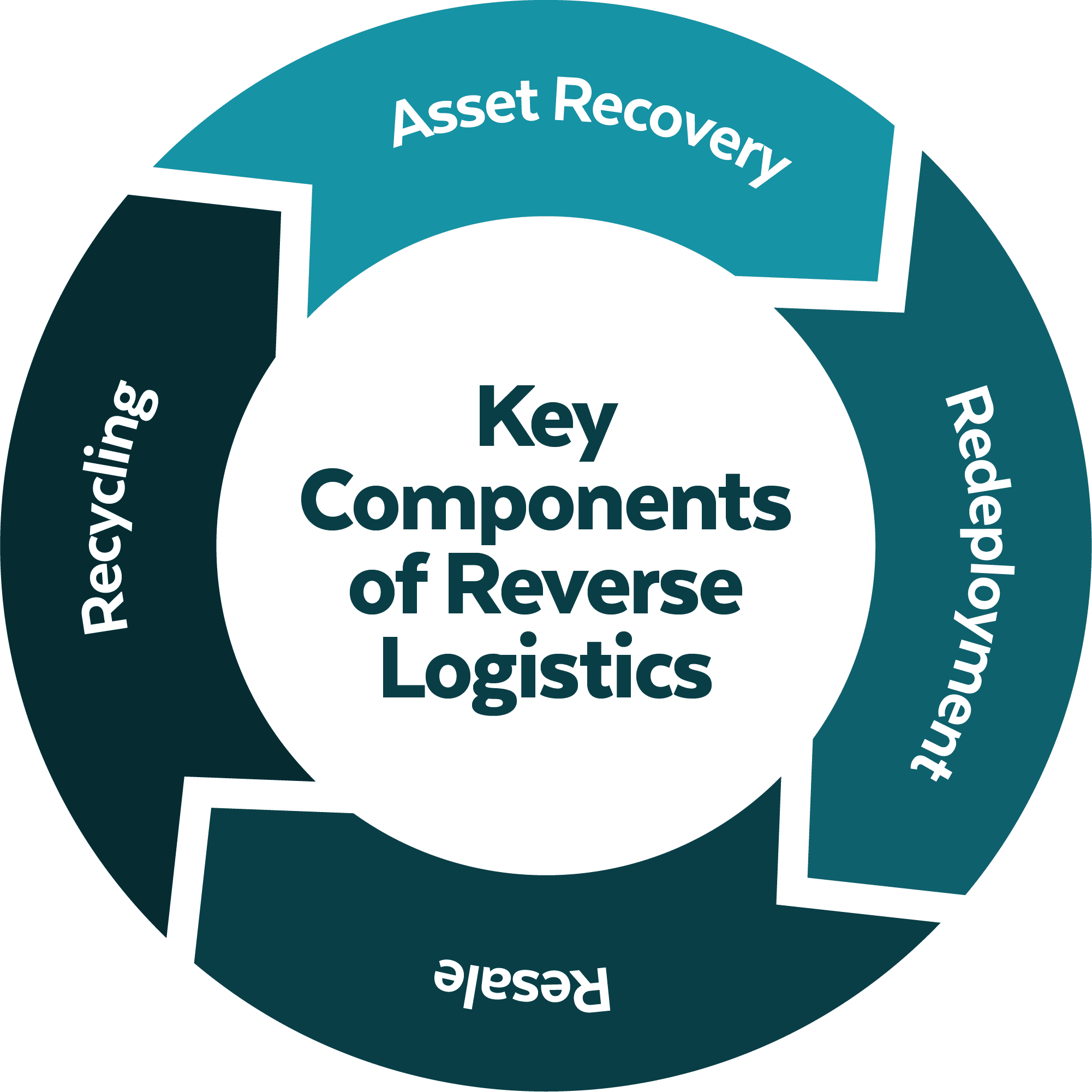
Asset recovery: Getting IT equipment back into the system
An example of this is a company upgrading all employee laptops. Instead of discarding the old ones, they collect them, wipe sensitive data, and determine which devices can be refurbished or repurposed.
Redeployment: Giving assets a second life
In this case, a business redistributes gently used monitors, docking stations, and keyboards to new hires or secondary offices instead of buying new equipment.
Resale: Recovering value from old IT assets
An example of how a business can recover value is an enterprise selling off used but functional servers to smaller businesses, unlocking hidden revenue instead of writing them off as losses.
Recycling: Disposing of equipment responsibly
Devices that are at the end of their life can be sent to certified e-waste recyclers so that valuable metals are recovered, and hazardous materials don’t end up in landfills.
Why traditional disposal falls short
Most companies historically followed a “buy, use, dispose” model, leading to lost ROI. Assets depreciate fast, but that doesn’t mean they have zero value. Reverse logistics can help recoup the costs.
Another thing to worry about is security. Improper disposal of IT assets can lead to data breaches, especially if those old devices still contain sensitive company and customer data.
Reverse logistics is about making strategic, sustainable decisions that benefit both your business and the environment.
Want to optimize your IT asset lifecycle with a strategic reverse logistics plan? Let’s talk.
Case study 1: Enhancing asset lifecycle transparency & management
The world’s most popular social networking platform came to us for help.
They didn’t have clear visibility into their asset inventory, making it hard to track their hardware and peripherals.
They also wanted to improve their process from Acquisition to Reverse IT logistics.
The other challenges they faced were multiple disconnected data sources, which blocked a unified view of their IT infrastructure. Moreover, assets were often lost during ownership transitions, throwing a wrench into operations and productivity.
What we did:
Imagine knowing exactly where every single IT asset is, from the moment it arrives to the day it’s retired. That’s the kind of control we gave our client, the world’s most popular social media platform.
After auditing their IT lifecycle management process, we saw their IT supply chain could be improved. So, we streamlined it.
By implementing best practices and a single, easy-to-use asset tracking platform, we helped optimize their entire process.
The outcomes:
We support around 20,000 users across North America, managing 100,000 assets worth $60 million. That includes 50,000 assets actively in use and another 50,000 stocked in our inventory warehouses. Our team runs efficiently with a 200:1 user-to-technician ratio. Just 100 inventory technicians keep things running smoothly for 20,000 users.
Plus, we move fast—80-85% of requests are processed and deployed the same day, so people get what they need without delay.
Case study 2: Optimizing IT inventory for a Fortune-10 company
Our client—a Fortune 10 tech company with thousands of AV rooms and IT assets across multiple offices—had no clear IT asset lifecycle strategy. Their IT team was constantly reacting instead of staying ahead of problems.
Ticket avalanche
User-reported incidents surged, swamping IT teams that didn’t have the bandwidth to keep up. Response times? All over the place. Downtime? Steadily increasing.
AV room failures at the worst possible moments
No proactive room inspections meant issues went unnoticed until a big meeting or event. Then, boom. Glitches. Frustration and delays.
The Fix: A proactive IT asset lifecycle strategy
We stepped in and built a system that stopped problems before they started.
- Remote-first IT & AV support—so issues could be handled faster, with on-site techs available when needed.
- Proactive AV room checks—to catch potential failures before they disrupted meetings.
- A smarter ticketing system—for efficiently tracking, analyzing, and resolving IT issues.
- Data-driven asset management—to optimize performance and retire failing assets at the right time.
The results:
- 10% drop in IT incidents—fewer disruptions, faster fixes.
- 10,000+ AV rooms checked per month—no more surprise failures.
- 1,000+ events supported in 5 months.
- 100% of remote AV issues were resolved—traveling techs handled them, and no escalations were needed.
Need help crafting an IT asset lifecycle strategy? We’re here to help.
IT Asset Lifecycle Management’s five stages—Planning, Acquisition, Operation, Maintenance, and Reverse IT Logistics—can help you save time, cut costs, and future-proof your business by encouraging your IT and business teams to work together.
With the right strategy, you’re doing more than picking new assets or cataloging older ones—you’re ensuring every piece of tech serves a tangible business goal.
And with our expert guidance? You’ll make choices that drive results. For more information, contact our asset lifecycle experts.
To learn more about who we are and what we can do for you, go here.