


.jpg)

Blog//
Cloud Infrastructure-as-Code Automation Value Model for ROI Optimization
February 1, 2026
November 13, 2025

This blog introduces the Cloud Infrastructure Automation Value Model, a framework designed to help cloud, operations, and business leaders evolve automation in a structured way. It uses a two-dimensional matrix that maps four maturity stages against five levels of infrastructure complexity, with distinct business outcomes and implementation requirements for each intersection.
As AI increasingly enables automation—from generating infrastructure code to enforcing policies, it also introduces new complexities that require careful governance. The model allows for organizations to assess their current state, identify challenges, and chart a practical path toward greater efficiency, agility, and maximize business value.
The cloud infrastructure automation Imperative
Cloud platforms have become the backbone of digital business, dictating how fast organizations innovate, how resilient they are to disruption, and how effectively they manage cost, compliance, and scale. Yet, many enterprises rely on manual operations for provisioning and configuring infrastructure, where human error leads to configuration drift, costly security incidents, and audit failures.
Modern ‘as-code’ practices, which extend Infrastructure as Code (IaC), integrate security, configuration, and compliance policies, promising faster deployments, fewer errors, and consistency at scale. Additionally, a new technique called “Infrastructure from Code (IfC)” is emerging, which directly generates the required infrastructure from the application’s codebase. However, without organizational readiness, automation can introduce more operational debt than it removes.
Bridging the AI-driven automation gap
The gap in automation maturity widens as AI agents now enable natural language translation into production-ready code for infrastructure provisioning, policy enforcement, compliance, cost, and architectural standards. In practice, this gap manifests through fragmented tooling across teams, inconsistent tagging and naming conventions, manual security reviews, ad hoc configuration changes, and a lack of integrated policy enforcement. AI-generated infrastructure code also requires proper governance.
Only 8% of enterprises today qualify as “highly cloud-mature,” according to the 2024 HashiCorp–Forrester State of Cloud Strategy Survey, underscoring how few organizations have the foundational processes needed to scale intelligent automation effectively. Organizations lacking automation maturity struggle to leverage these new AI-driven capabilities, which are rapidly becoming key differentiators in the competitive landscape.
That’s the reality: Automation is not binary; it’s a capability curve. Treating it as an On/Off switch leads to misalignment and inefficiency.
The Astreya Cloud Infrastructure Automation Value Model helps close this gap through a structured maturity–complexity matrix that guides leaders in assessing their current state, anticipating challenges, and scaling automation with clarity and control.
Understanding the present state of cloud automation
Cloud adoption often begins simply, with manageable workloads and a limited number of accounts. However, as adoption scales, complexity inevitably increases. When numerous engineers make changes using diverse tools and scripts, it can lead to slow coordination, delayed deployments, security drift, and unpredictable cloud costs.
This expansion often creates underlying tensions, such as:
- Agility vs. control: Teams desire independence but fear losing oversight
- Velocity vs. stability: Operations prioritize stability but face pressure for rapid delivery
- Predictability vs. uncertainty: Finance seeks predictability but encounters inconsistencies
Without a well-defined framework, automation can become fragmented, inadvertently generating more problems than it solves, such as inconsistent tagging and naming conventions, duplicated automation scripts, unmanaged service accounts, noncompliant resource configurations, overlapping IaC templates, and manual workarounds that bypass governance. This leads to operational debt, a state where automation outpaces readiness or infrastructure scales faster than its supporting automation.
The skills gap hindering automation maturity
Gartner projects that by 2026, only 60% of infrastructure and operations teams will have the necessary automation and cloud skills—up from just 30% in 2022—highlighting the ongoing readiness gap that continues to slow enterprise automation maturity.
Organizations need a model that aligns automation capabilities with increasing complexity, ensuring each advancement strengthens the environment rather than straining it, with a focus on delivery agility and risk reduction.
Understanding the two axes of cloud infrastructure automation maturity
The Cloud Infrastructure Automation Value Model maps organizational maturity across two dimensions: the level of automation, ranging from manual to fully automated, and the business value realized, from operational survival to strategic advantage.
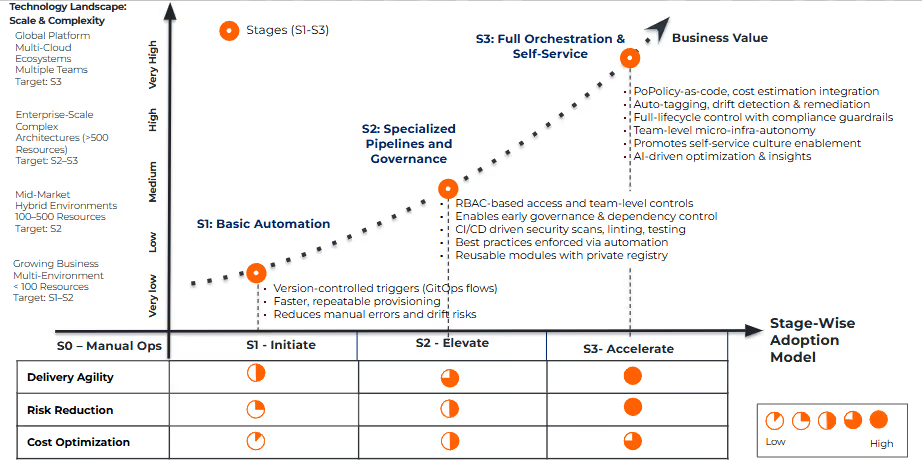
The X-Axis: Automation maturity & business impact
S0 – Manual Operations: Everything is human-triggered. Provisioning and configuration happen via console clicks or ad-hoc scripts. Delivery takes days (from request to production). Deployment time is roughly 4–6 hours for manual execution, excluding approval delays. Change failure rates typically range from 25% to 30%, with production incidents occurring on a weekly basis.
S1 – Initiate (Basic Automation): GitOps has become the standard for accelerating provisioning and minimizing manual errors. Typical deployment time is under 45 minutes, with change failure rates ranging from 10% to 15%, and a monthly incidence of drift-related issues. Basic monitoring and alerting, often powered by cloud provider tools, come into play. Governance remains minimal, focused primarily on consistency rather than security.
Notably, some organizations initially experience a 10% increase in deployment time as teams adjust to new processes.
S2 – Elevate (Specialized Pipelines and Governance): This stage introduces role-based access control, early governance gates, dependency management, and integrates security scans, linting, and testing into pipelines. Guardrail-enabled AI supports code generation, anomaly detection, and accelerates issue triage. Deployment time averages 15 minutes, with a 5% change failure rate and quarterly incidents. Risk is reduced roughly by 70% compared to S1, with compliance dashboards in place, and around 20% cost savings are achieved from waste reduction.
S3 – Accelerate (Full Orchestration and Self-Service): Policy as code, cost estimation, drift detection, and automated remediation are standard. Teams operate autonomously within safe boundaries, supported by AI-driven optimization and self-healing with industry-leading tools.
Deployments take under 5 minutes, change failure rates drop below 2%, and self-healing prevents about 90% of incidents. Cost savings of 30–40% are achieved through automated rightsizing and resource optimization. Even at this stage of maturity, some organizations face “automation sprawl” due to excessive tool proliferation.
Moving from left to right along the X-axis reflects increasing maturity, governance, and business impact—with occasional bumps that leaders must navigate.
The Y-Axis: Scale, complexity & organizational readiness
This axis reflects the inherent complexity of the cloud environment, defined by scale, platform diversity, and team distribution.
NOTE: For scoring methodology, see Section 4: Complexity Calculator.
Startup (Very Low Complexity): Single team managing fewer than 50 resources in a single environment. Focus is on basic provisioning and manual processes. Target maturity: S0–S1.
Growing Business (Low Complexity): Fewer than 100 resources and multi-environment setups. The focus is on consistency and drift prevention. Target maturity: S1–S2.
Mid-Market (Medium Complexity): 100–500 resources with hybrid environments. Requires pipelines and reusable automation to avoid fragmentation. Target maturity: S2.
Enterprise Scale (High Complexity): More than 500 resources, multiple teams/business units, and complex architectures with several environments. Needs governance guardrails, orchestration, and meets several compliance standards. Target maturity: S2–S3.
Global Platform (Very High Complexity): Multi-cloud, distributed teams across business units. Requires self-service, embedded governance, and AI-driven optimization. Target maturity: S3.
Moving upward along the Y-axis reflects increasing demands for automation to manage risk, scale, and efficiency.
Example matrix: Automation maturity across scale & complexity
Legend:
🟢 Optimal – Target state for your complexity
🟡 Transitional – Functional, but plan to evolve
🔴 Critical – Immediate action required
⚫ Over-engineered – Wasteful for your scale
The complexity calculator
To apply the model effectively, leaders need to quantify their complexity. The Cloud Automation Complexity Estimator provides a weighted scoring system across five drivers:
Scoring methodology
Each driver is scored from 1 to 5, then weighted according to its impact on automation complexity:
- Number of Teams: Important but manageable with good coordination processes.
- Cloud Resources: Scale matters based on the architectural pattern
- Change Frequency: Frequent changes require more robust automation.
- Environment Variability: Multiple environments exponentially increase complexity.
- Regulatory & Security Requirements: Compliance is critical and non-negotiable.
The total weighted score maps to the recommended maturity stage:
- Score < 2.0 → Target Stage S1 (Basic Automation)
- Score 2.0-2.9 → Target Stage S2 (Pipelines & Governance)
- Score ≥ 3.0 → Target Stage S3 (Full Orchestration)
Worked example
The table below provides two worked examples to illustrate the application of the complexity estimator.
Calibration Note: Most organizations underestimate complexity by 20-30%. If your score lies near a threshold, round up to ensure resilience and avoid risk.
Benefits of advancing maturity
Benefits grow with maturity but depend on proper implementation. Beyond cost and speed, maturity improves team collaboration, visibility, and IT-business alignment. Key benefits by stakeholders are outlined below.
Note: Reality Check – These benefits are not guaranteed. Poor implementation can double your costs with zero ROI.
Assessing your current state
Before embarking on any automation journey, organizations must start with a clear understanding of their current state. This means assessing both technical maturity and organizational readiness as interconnected pillars.
Why It Matters
Without an honest baseline, automation efforts become aspirational rather than actionable. You can’t improve what you haven’t measured, and you can’t scale what your teams aren’t ready to sustain. Also, without control, automation creates risk—not velocity.
A simple self-assessment framework
Use these metrics to benchmark your current state and revisit biannually to track progress:
- Mean Time to Recovery (MTTR): How quickly do you recover from failures? Low MTTR indicates strong resilience.
- Deployment Frequency: How frequently do you deliver changes? Higher frequency suggests agility.
- Change Failure Rate: How often do changes cause issues? This highlights process quality and automation maturity.
- Lead Time for Changes: How long from idea to production? This reflects responsiveness.
- Infrastructure Cost per Unit: Are you optimizing spend relative to business output?
Go beyond metrics—Assess organizational readiness
Scaling automation requires the right mindset, processes, and support structures:
- Do your teams have the skills to adopt and extend automation?
- Is there a governance model to manage risk and enforce standards?
- Does your culture enable experimentation and learning, or penalize failure?
- Are roles and responsibilities clearly defined for ownership and remediation?
Insight: Culture and clarity, more than tools, are often the primary blockers to maturity.
7. Strategies for advancing maturity
While automation models offer compelling visions, real progress depends on pragmatic execution. Enterprises must align their ambitions with operational realities and take deliberate steps toward achieving autonomous operations.
The Build-Scale-Optimize philosophy
Transformation follows a structured progression:
- Build (S0→S1): Establish foundations in lower environments. Focus on standardizing configurations, introducing IaC, and building team confidence.
- Scale (S1→S2): Expand into production with governance, monitoring, and compliance controls. Drive consistency and reliability across teams.
- Optimize (S2→S3): Enable self-service, intelligent automation, and proactive observability. Teams operate autonomously within guardrails.
Jumping from S0 to S3 in 12 months looks good in strategy decks, but typically fails. You’ll spend more time fixing automation than solving business problems.
Understanding the ROI trajectory
Expecting instant cost savings is a common trap. Automation pays off in stages:
- Immediate term: Initial spike in cost and effort due to tooling and upskilling
- Short-term: Stabilization and break-even as processes mature
- Long-term: Tangible savings through reduced toil and higher velocity
Early ROI comes from speed, risk reduction, and team productivity—not just cost savings.
Change management > Tooling
Success requires equal focus on technical implementation, process transformation, and cultural change. You can buy advanced automation tools, but without cultural readiness, they won’t stick.
The following highlights the strategy for advancing maturity, including common pitfalls to avoid and key enablers to consider.
Stage S0 -> S1 – Foundation Building
Objective: Create consistency, reduce errors, and establish the groundwork for automation at scale.
Capabilities Introduced:
- Infrastructure as Code (IaC) for version-controlled provisioning.
- Standardized environments to avoid configuration drift.
- Basic monitoring and alerting for real-time visibility.
- Defined ownership and change approval processes.
Stage S1 → S2 – Scaling Automation
Objective: Enable secure, cost-aware developer autonomy while expanding automation across teams.
Capabilities Introduced:
- Automated security and compliance scanning in CI/CD pipelines.
- Self-service infrastructure catalogs with pre-approved templates.
- Policy-as-code for budgets, tagging, and resource governance.
- Cross-team collaboration through reusable components and shared practices.
Stage S2→ S3 – Autonomous Operations
Objective: Shift to intelligent, self-regulating infrastructure that aligns with business KPIs.
Capabilities Introduced:
- AI-driven observability with predictive analytics.
- Self-healing infrastructure with automated remediation.
- Real-time drift detection and correction.
- Business-aligned automation metrics (e.g., uptime, MTTR).
Role of AI agents across stages: Today’s role & future promise
Build foundations first, amplify with AI second. At every stage:
S0 → S1: AI Writes Your First Code
- Auto-generates ~70% of Infrastructure as Code (IaC) templates
- Saves up to 40% of development time
- Risk: Unreviewed AI-generated code may introduce security vulnerabilities
S1 → S2: AI Diagnoses Your Problems
- Correlates alerts, triages incidents, and suggests remediations
- Cuts troubleshooting time by up to 60%
- Risk: Poorly tuned models can generate alert fatigue or false positives
S2 → S3: AI Runs Your Operations
- Powers self-healing systems, auto-scaling, and continuous policy enforcement
- Prevents up to 90% of known incident patterns
- Risk: Without proper guardrails, AI actions can trigger cascading failures
Build foundations first, amplify with AI second.
The journey is cumulative: automation provides the scaffolding, AI multiplies the impact—turning reactive operations into intelligent, self-sustaining systems.
Future-state vision for an autonomous advantage
By 2028, leading enterprises won’t just automate, they’ll run autonomous cloud infrastructure that self-heals, ensures real-time compliance, and lets developers focus entirely on delivering business value. This outlook aligns with Gartner’s Hype Cycle for Emerging Technologies, which identifies autonomous AI and self-managing systems as key transformative trends shaping enterprise operations (Gartner, 2025).
It is further supported by emerging research on Autonomous Infrastructure and Self-Healing Clouds, which envisions infrastructure capable of auto-recovery, self-optimization, and continuous adaptation with minimal human intervention (ResearchGate, 2025).
But the gap between leaders and laggards is widening today. You can’t bolt on AI to a weak foundation later. Success demands a deliberate progression, not reactive fixes.
Your immediate action plan
- Benchmark your current automation maturity against industry standards
- Align automation with your environment’s complexity
- Track progress using metrics like deployment velocity, MTTR, and cost per workload
- Invest holistically across people, processes, and platforms—not just tools
Critical success factors
- Introduce AI only where you have data readiness, not just interest
- Build incrementally, rushing creates tech debt, waiting creates disadvantage
- Prioritize measurable outcomes: 10x faster releases, 99.99% uptime, 30% lower costs
The bottom line
Right-sized automation wins. Start where you are. Use what you have. Move with intent. But start today.
Speak with a Cloud & Infrastructure expert